Sexing is an evaluation based on a variety of factors, all of them vague. The sex organs are all internal so we have to go with external clues. (Yes, there are some people with nimble fingers that can gently squeeze on the vent and peek inside and make a determination. I — with my arthritic clumsy fingers — am not one of those people.)
The external clues that we work with are: wing feathering, comb & wattle development, and behavior. We put a blue band on them when we observe a clue and if a chick gets two bands it is counted as male.
Wing Feathering:
Feather-sexing works on mixed breed chicks where the dads are fast normal-feathering males and the moms are delayed-feathering females. None of the breeds I work with are of this sort, so they cannot be sexed with wing feathering.
Here is a chart that is often presented as a one-stop-fits-all wing- or feather-sexing chart. Don’t fall for it.
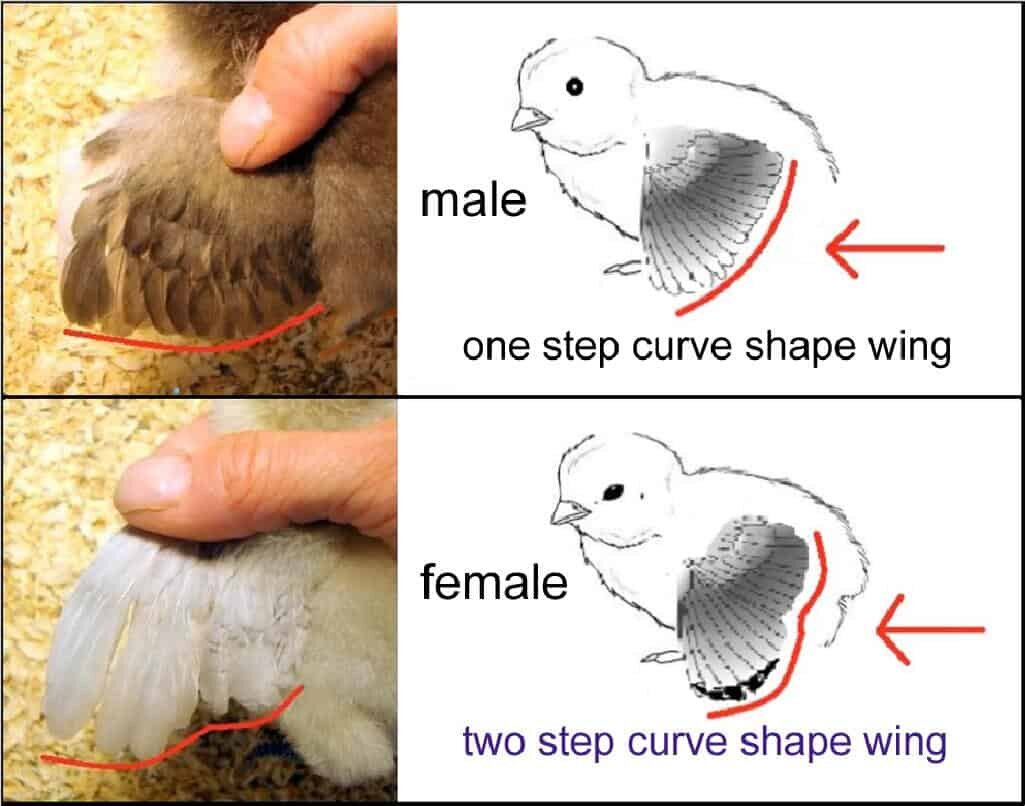
Image source: https://cs-tf.com/how-to-sex-chickens/
Comb & Wattle Development
If we see chicks with brighter and bigger combs than their hatch mates, we tag those as probably male. If we see a red flush on the jawline, we tag those as probably male. These usually don’t show up until they are at least three weeks old, and we usually sell the chicks long before then.
Behavior
If we observe dominance behavior — military posture, pecking at us, giving us the stink-eye, or charging us when we open the brooder — we tag those as probably male. Crowing obviously is a big clue. If the chickie crows, we don’t wait for a second clue. Again, this is an older chick clue. Not something we would see in the few days between hatch and pick-up.
Auto-sexing Breeds
Auto-sexing breeds are supposed to hatch with distinctive markings or feathering. In my experience, some breeds are more reliable about this than others. Plymouth Blue Rocks and Bielefelders, for example, have hatched 1/3 obviously male, 1/3 obviously female, and 1/3 obviously not-obvious. With these, I list the first two thirds as such and list the final third as straight-run and wait for some other clues to come into play.
Summerdell Chicks and ISA Browns, bless them, do hatch obviously female and male.
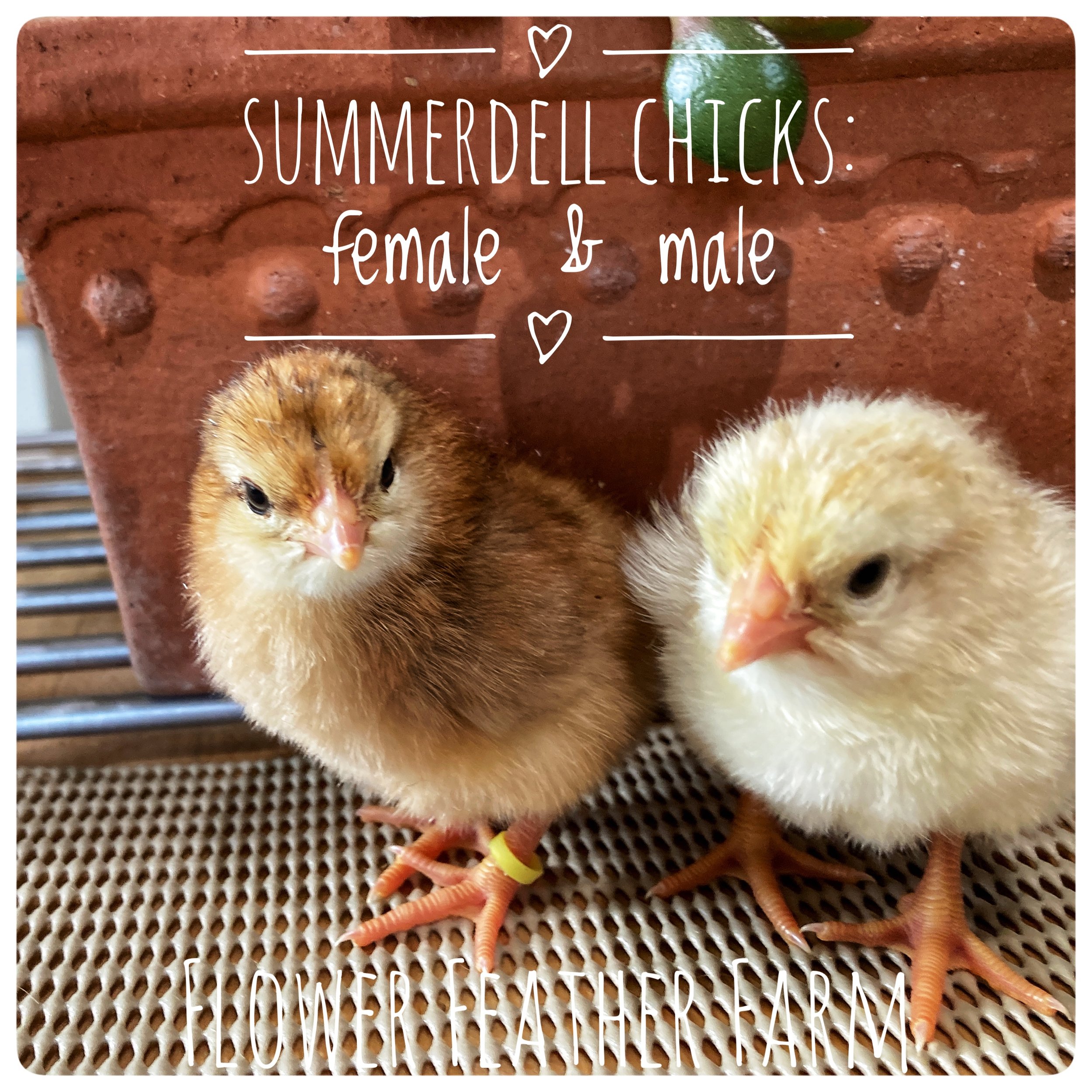
Female and Male Summerdell Chicks
Straight-Run Hatchlings
Most of the chicks that leave us are sold as straight-run hatchlings. We have no way to ensure that they are female. If they are tagged twice as males, we won’t hand them to you as straight-run, as that wouldn’t be fair. But as most chicks are picked up within days of hatching, we really haven’t a clue: expect 50% males and 50% females.
Pullets
By about six weeks — if we haven’t sold out yet (what a crazy year this has been), we feel confident that the ones that are not tagged as male are female and list them as Pullets. Most of the time, they are Pullets. And sometimes they keep their identity secret and surprise us all when they start crowing. We had a four-month old pullet start crowing. Everything about her said female, until it didn’t.
So if you pay for a Pullet and she turns into a Cockerel, please know that I did my best. And please let me know so I can help you rehome him and make things right with you.

You’ve ordered your chicks and set your pick-up appointment. Now what?
Now is a great time to do a little reading so that you are well-equipped to take excellent care of your little ones.
As chick season heats up, I want to talk to you about Chick Flippers. These are people who place large orders from commercial hatcheries, have the chicks shipped in, and then list them for sale at a HUGE mark-up on Craigslist etc. They don’t disclose . . .
Please oh please don't use a feather duster. Yes, they will love it, but when you find the one that got tangled in it and hung herself, you will feel awful.
Well that depends on many things, chiefly the weather and what does your outside set-up entail.
The rule of thumb is that they need to be ten weeks old if the over-night low is going to be around 30.
That said, I put them out at four weeks at about any time of year. What? Yes. Four weeks, with supplemental heat.
One of my customers — a first-time chicken dad — glibly remarked, “I think I’ll get into breeding, how hard can it be?” One of my more diplomatic friends responded, “You would be surprised.”
No, this is not a dating guide. If you are looking for your soulmate, volunteer with an organization that aligns with your values and priorities. All those other volunteers are your pre-filtered field of candidates. Now, back to chicks . . .
Are you just planning on just one round of chicks? Let me save you the trouble of gathering up all the necessary supplies.
Great question. Chick prices vary according to availability, quality, and investment.
I’ve shared quite a few of my best tips and tricks for setting up a chick brooder, but what about the next step? When they are too little to just toss into the big girl coop, but too big stinky to stay in the house.
At this point, I put them in the big girl coop, with accomodations.
I house birds of different ages together regularly. Here is how I introduce them.
Stella Stargazer: before and after Selenium treatment for wry neck.
Medicated Chick Starter and Fermented Feed.
Girl Chick? Boy Chick? How is one to know?
Sexing chicks. Alas, not as easy as we would wish.